Since starting this project I have learned a lot about old music notation and I want to share some of the things I have learned in hopes that it helps other people learn too.
- Dots below notes mean that you play that note with a finger, and diagonal lines mean you play sustain the note. I am planning on including both these notations in future transcriptions once I figure out how to do it in Musescore.
- Time signatures are not standardised between composers or even within work from the same composer. Cut time (a C with a vertical line through it) is the same as in modern notation (2 minims per bar) but for songs with 3 beats in a bar there is just the number 3 (or a C with a line through it followed by a 3), and you have to count how many notes are in the bar to find out if they mean 3/4, 3/2 or even 3/1.
- With Mudarra’s work he used the time signature as a representation of tempo, with
 (a circle with a vertical line through it) meaning fast or allegro and
  (a C with no line through it) meaning medium or moderato. In his other work a C with a vertical line through it is used to mean slow or largo.
- With Mudarra’s work he used the time signature as a representation of tempo, with
- Besides Mudarra’s work none of the other pieces have tempos (which is the main thing that has stopped me from making mp3 and midi files of every song) so I have no idea how fast any of them are meant to be (besides dances like Pavanes and Gaillardes and Bransles because I am primarily a dance musician and can also ask dancers how fast songs should be)
- Repeats weren’t directional, meaning you couldn’t write a “repeat back to this bar” without a repeat on the previous bar. A way that composers got around this was with an old form of D.S. al Fine, which was a weird symbol (
 or
or ) that marked where you would repeat back to (or from), and you would play until you reached either the Fin. or the end of the piece. Sometimes the symbol is on the tablature with the notes, either to save printing space or to just be annoying.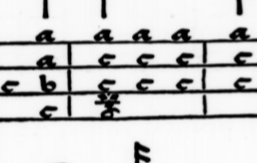
- Some songs are tuned in FCEA instead of GCEA. The two ways I have found of notating when a song is in FCEA is “Temple Viejo” (which is Spanish for “old tuning”) and “A corde avallée” (which, according to google translate, means “lowered rope” in Corsican, which I am assuming means lowered string).
- NOTE: I found this out after notating other songs and didn’t know what “A corde avallée” meant so I wrote “Vieux Temple” which is a French translation of “Temple Viejo”. This is incorrect and I will try and replace the old files with an updated version that says “A corde avallée” instead of “Vieux Temple”.
- Fermatas are used more to signal the end of a song instead of “hold this note twice as long” as it is used in modern notation, and it also replaces the symbol for the note length.
Hopefully some of this has been helpful, please feel free to contact me if you have any questions or corrections.
 Duarte's renaissance guitar blog