

In 2020 I decided to make a replica of a 4 course renaissance guitar. Because I don’t have much woodworking experience and no access to a lot of the tools I would need to make one from scratch I decided to buy a cheap baritone sized ukulele and add more strings to it myself.
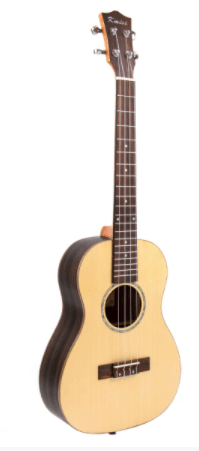
I started with a Kmise Solid Spruce Baritone Ukulele as I had bought ukuleles from Kmise before and they are decent quality for the price. It took a while to arrive (I ordered it in November and it didn’t arrive until mid January 2021) but once it arrived I got to work.
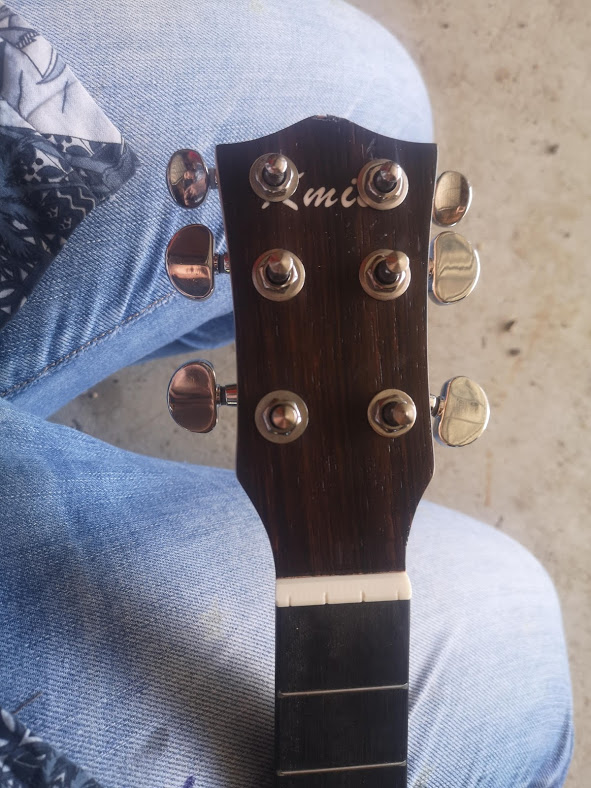
I couldn’t find ukulele sized tuning pegs so I had to use guitar ones, which is why in this image the bottom 4 pegs are larger than the top 2 (which are the original). I couldn’t fit the two additional pegs between the originals like I had initially planned but I managed to squeeze them in on top. However, this didn’t leave any room for a 7th peg to make this a proper 4 course guitar.
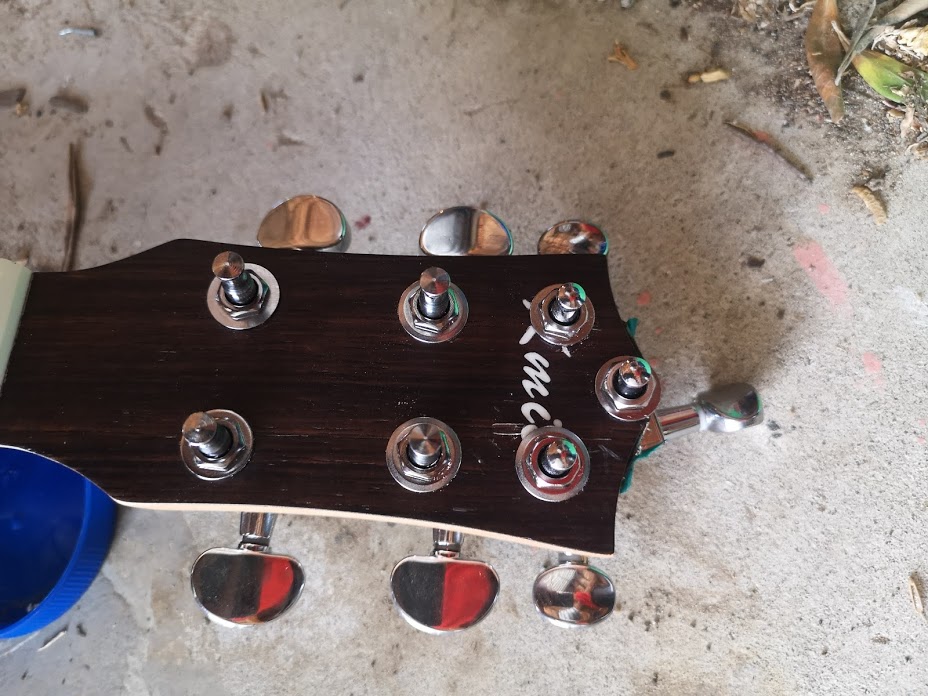
What we ended up doing was making a little divot in the top of the head that could fit the 7th peg and then attaching it with a small metal strap (that I think used to be a jigsaw blade or something) that was screwed in on either side. This holds surprisingly well and, while it does buzz sometimes, it still works which is great when you’re going for a cheap replica.
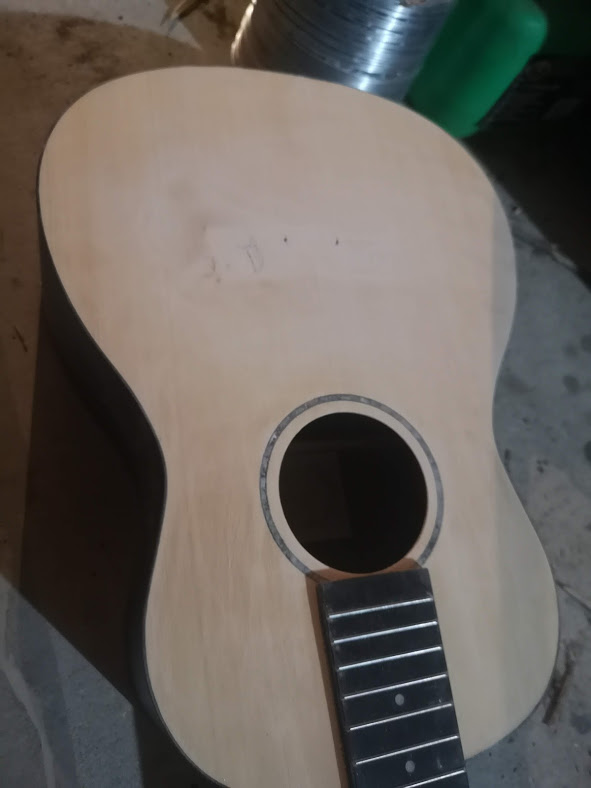
Next we removed the bridge so I could drill more holes in it, which took a lot more effort than expected. We didn’t realise that there were tacks holding the bridge on so when we used a heat gun and a chisel to remove the bridge we left a few scorch marks and dents that you can see in the above photo.
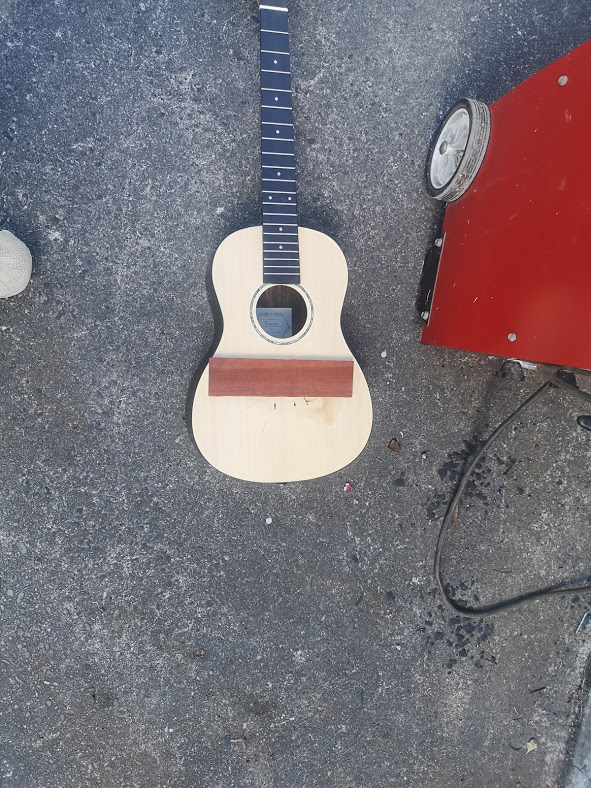
I then went to a different friend’s workshop and found a nice scrap piece of Australian redwood to carve into the “moustache” shape that renaissance guitar bridges formed.
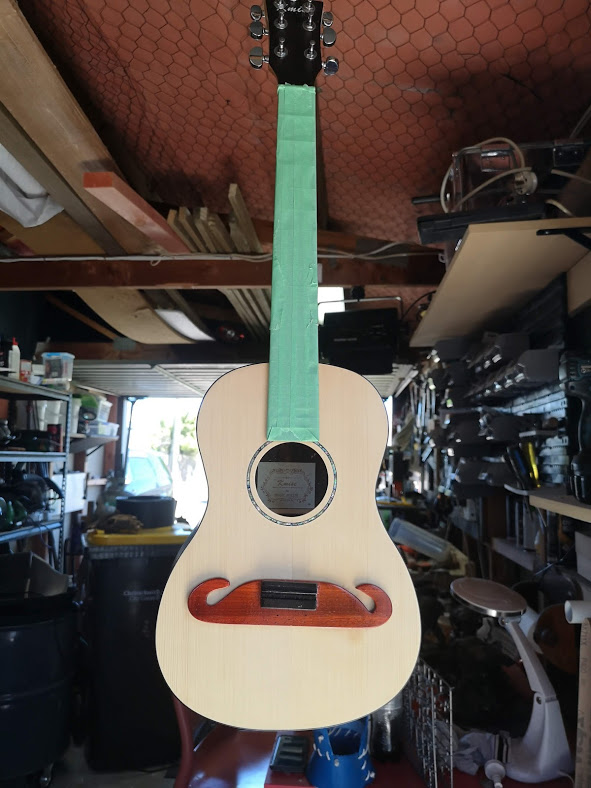
I glued the original bridge overtop the “moustache” and we let the epoxy set for a few days before I could finally play it. Then I strung it up and was finished, or so I thought.
An important thing to know about woodworking is you should varnish your wood AFTER you have glued it all together, as sticking varnish to varnish doesn’t hold for very long. I was at a week-long medieval camping event the first few times the bridge broke off. The first two times were the two bridges coming unstuck from each other and I sanded them down before gluing them again, and the third time was because I only had basic wood glue which wasn’t quite strong enough (as well as having string tension issues but we will get to that later) so I had to wait until I got home to use some stronger epoxy. The original bone bridge saddle also got lost when the bridge broke off a third time (the bridge snapped while I was on a gravel road and it launched the saddle into the ether) but thankfully my friend had some ethically sourced zebra bone for some reason and we made a new one that sounded just as good (and looked better, who knew Zebra stripes went down to their bones?)
I kept running into issues with string tension as I couldn’t tune it in the right octave without it being too tight and the bridge breaking off. After I fixed the bridge a 3rd time with stronger epoxy I kept it tuned an octave down which was fine except for volume reasons. I am surprisingly self conscious when it comes to my music playing so I was fine with this until someone who was sitting less than 3 metres away was complaining that she couldn’t hear me so I decided to tune it up an octave because I figured the epoxy was strong enough. It was, at least for a few days until I was just sitting in my bedroom and I heard a loud BANG as the bridge suddenly snapped off. The fourth (and most recent) time we reattached the bridge we put some copper tacks to hold it in so if the bridge breaks off another time it will bring the whole body with it. As of writing this I still haven’t found the zebra bone bridge so I am temporarily using two skewers I have glued together and sanded into shape (it’s not a good solution but it is better than nothing).
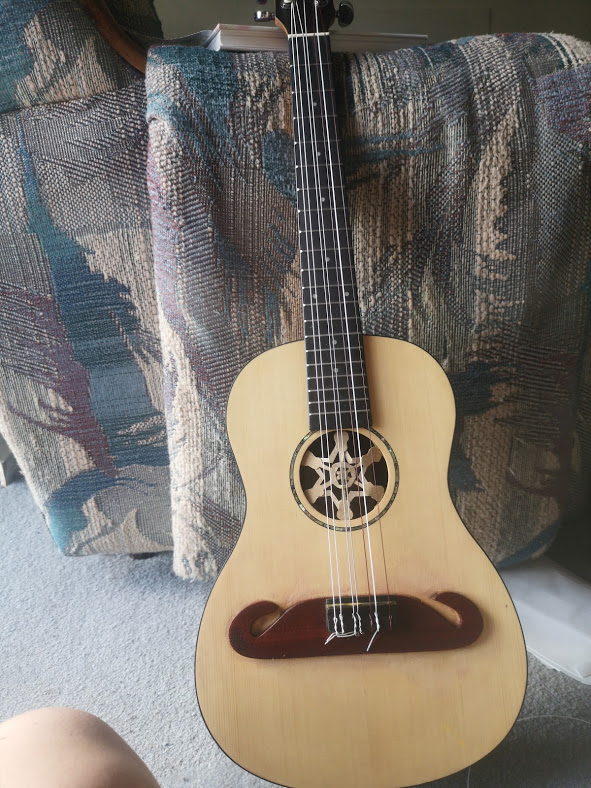
Another thing I replaced when I reattached the bridge the fourth time was the strings. Baritone ukulele strings were way too big so I ended up getting concert ukulele strings, one set with reentrant tuning and one set with low G tuning so the lowest course could have the traditional octave interval. I use alternating Aquila Nylgut and Aquila Red strings because it gives it a nice tone and it also matches my SCA device (which I would link if the Lochac roll of arms updated and added me, but it is also on my About page if you want to see it) because I love putting my SCA device on everything I can find. The red concert strings look much nicer than the red baritone strings as only the top string is wound with metal and it is wound with a red metal to match the rest of the strings instead of only the bottom two strings being reddish (like in the picture above, which is the baritone strings. I should take a better picture of the strings when it isn’t midnight). The rosette in the above picture is just made out of a cut up manilla folder but I have since removed it because I couldn’t find a good way to keep it in (as usually you’d glue it on before assembling the instrument, which doesn’t work when you buy a pre-assembled instrument and modify it)
My partner lovingly nicknamed my renaissance guitar “Mumbo Strumbo” (or just Strumbo for short), after the Minecraft youtuber Mumbo Jumbo who is known for his Minecraft skin having a moustache that my renaissance guitar’s bridge resembles. So in future if you see me refer to Strumbo you know it is the renaissance guitar I modified.
That is about everything I can think to write about with making Strumbo, please contact me if you have any questions or would like me to post more pictures (or maybe videos) of Strumbo. Thanks!
 Duarte's renaissance guitar blog
So. I should just build a baritone ukulele and add more strings? I can do that. I’ve been building tenor and soprano ukuleles for 12 years now, I can build a baritone (I have all the required jigs somewhere in the shop). But baritone tuning is NOT the same as tenor, concert, or soprano. Will not get you to GCEA.
LikeLike