Welcome to my guide on how to read renaissance tablature! It is very similar to modern Ukulele tablature, except better (in my opinion anyways).
Each line corresponds to a string or course (two strings), with the top line representing the highest string (except with Alonso Mudarra’s tablature where the top line represents the lowest string. It is the “right way up” with my transcription of it but it is still “upside down” in the original manuscript). The standard tuning for a renaissance guitar is GCEA (same as a modern ukulele), except for some pieces which have “old tuning”, where the lowest string is tuned a whole tone lower making it FCEA.
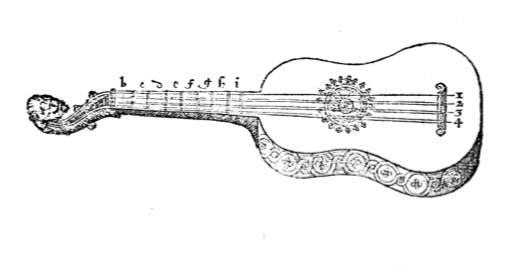
In Italian tablature (used in Mudarra and Barberis’ tablature) numbers on the lines are used to represent which fret you play (0 being open, 1 being first fret, 2 being second etc., with X being the tenth fret). In French tablature letters above the lines are used instead (this style predates notes having letter names, what we would call C D and E were instead referred to as Do, Re and Mi. This was much less confusing to the average 16th century French guitar player than it is to a modern ukulele/guitar player). An a represented leaving the string open, b represented the first fret, c the third and so on. The diagram below from Pierre Phalese’s Selectissima elegantissimaque demonstrates much better what I just tried to explain about frets in French tablature.
Below are some note lengths (breve, semibreve, minum, crotchet, quaver, semiquaver) in Italian and French notation. Note that (despite the note heads being diamond shaped rather than round) Italian notation is pretty much identical to modern notation.
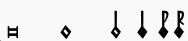

If there is no marker above a note it is the same length as the previous note (mostly to save on ink). Sometimes note lengths are repeated at the start of each bar, other times they are not. In my transcription they are, just for simplicity.
I think that covers everything, please feel free to contact me if you have any questions.
 Duarte's renaissance guitar blog